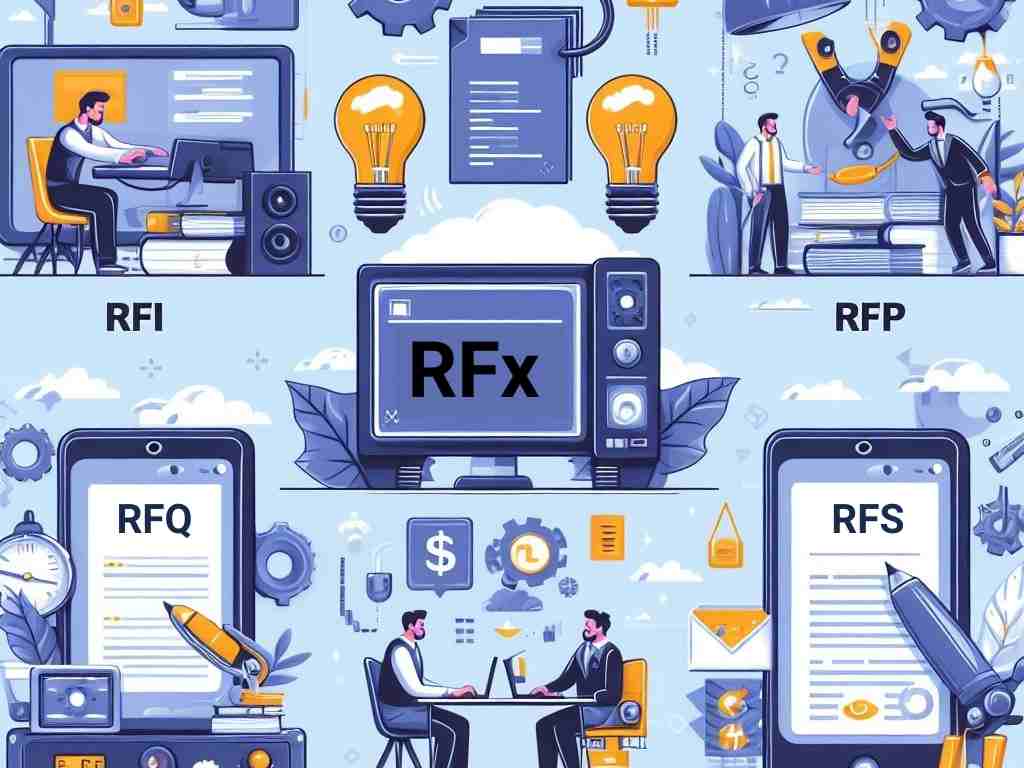
RFI, RFS, RFP, RFQ: What are the differences?
In real life, these terms are often used interchangeably, because many organizations do not understand the differences well enough, so buyers lose negotiating advantages by not using them properly. Likewise, vendors need to know the advantages of working under each type of request to maximize their chances of selling.
Although these purchasing models share some similarities, each one has a clear dividing line. Understanding the distinctions will help organizations run a better-defined vendor selection process as they build their vendor base.
Procurement leaders need to know how to carry out due diligence before sending these requests to vendors, so that it is easier for vendors to provide the best service.
Here is a summary of each procurement process: RFP, RFI, RFQ and RFS.

RFI (Request for Information)
RFI stands for “Request for Information”. It helps buyers present to vendors the general business challenges they face as they enter the market, and vendors can respond within the context of those requirements. Vendors do so by describing their market position and showing their product offerings, licenses and the rates offered to buyers.
- It is used when the buyer has little or no knowledge of the market it is about to enter, and its main goal is to learn what the market can offer around a product or solution.
- A request for information is a preliminary written document with basic information on any topic related to a product, service or solution.
- The RFI is more of a research document: it lets buyers ask vendors open questions and helps them learn about the vendors’ full offerings.
- At this stage, companies have not necessarily made a purchasing decision yet.
RFS (Request for Solution) or agile RFP
RFS stands for Request for Solution. It is a document that describes the business requirements of a solution or service to vendors, but gives them freedom in how they respond to those requirements. The RFS differs from the RFP mainly in its agile approach to building the solution: it sets up a collaborative process to work out the technical details with the vendor through design and solution-understanding sessions.
- The RFS process is mainly used when a quick response from vendors is needed on a topic that has not been technically defined in detail.
- It is used to address a need that may have multiple answers or solutions from vendors.
- The RFS is used to buy solutions and services that change continuously in the market, for example Software as a Service (CRM, HCM, ERP, etc.) and cloud-based solutions and services. Learn more in what an RFS is.
RFP (Request for Proposal)
RFP stands for Request for Proposal. It is a document that asks vendors to propose solutions to the client’s business requirements or problems. An RFP usually follows an RFI and is used when the company has made a purchasing decision.
- The RFP is used to obtain proposals for specific services and solutions from several vendors at once, with a firm price.
- An RFP defines in more detail a company’s requirements tied to the business objectives of a specific project.
- The document also defines and identifies the requirements and plans for the project being requested.
- Its core task is to give vendors enough detail for their proposal to contain a valid solution, while still leaving them room to apply best practices to meet the requirements.
- Any organization that wants to understand how quickly different vendors sell products and services can use an RFP. See also what an RFP is.
RFQ (Request for Quotation)
RFQ stands for “Request for Quotation”. A company looking for enterprise-level services has the chance to go deep into the exact specifications required.
- The RFQ defines the buyer’s requirements more precisely; there is no room for vendor creativity, unlike in an RFP or RFS.
- The vendor has no flexibility to suggest best practices and is expected to deliver predetermined solutions. The RFQ usually lists the buyer’s requirements in a table where vendors state whether they can meet each one.
- Based on those answers, the procurement team decides whether to continue with those vendors or look at another vendor base.
- It is mainly used for well-defined products or services where no variation is expected from the vendor.
IT Experts can guide you to get the most out of these contracting and purchasing processes according to your needs. IT Experts has a methodology applied to Vendor Selection, including IT know-how and Consulting Services to help you meet your business needs in an efficient, flexible, scalable and secure way while optimizing costs.