

In IT outsourcing contracts there is a comfortable belief: that value is lost during execution, in the invoice nobody audits, the SLA nobody measures, the obligation nobody claims. Industry evidence and thirty years of contract audits point to a less comfortable conclusion: value leakage shows up during execution, but it is designed before signing. This article develops that thesis from a real renegotiation case, presents the contract lifecycle framework that makes it manageable, and proposes a concrete recovery methodology.
One contract, five years, 150 changes
The case behind this analysis is a five-year IT outsourcing contract worth more than one hundred million dollars, awarded through an RFP to the vendor with the best technical and financial proposal. When preparing the renewal, a simple inventory revealed what day-to-day operations had normalized: more than 150 Project Change Requests (PCRs) signed during the term, an average of more than two and a half changes a month, sustained over sixty months.
The figure matters not because of the number itself but because of what it means contractually: the awarded document no longer described the real service. What was being delivered was the base contract plus 150 changes, many negotiated bilaterally, with no competitive pressure, no market reference and under operational urgency. Each of those conditions structurally favors the vendor; all three together, sustained for years, make up a systematic mechanism for transferring value. The seven dimensions where this transfer shows up are described in Value Leakage in IT contracts, and the mechanisms behind it in the anatomy of contract value leakage.
The most revealing element of the case is that the vendor’s compliance reports were flawless: green SLAs and deliverables on time, alongside deep client dissatisfaction. When reported performance and perceived experience diverge for a long time, the problem is rarely in the execution of the contract; it is in its design.
The pattern: vendors optimized to win RFPs
The case follows a recognizable pattern in the industry. Some vendors’ real product is not the service but the won tender: they design the delivery model with the bare minimum needed to formally meet each requirement in the RFP, and build the pricing model by reverse engineering to be the most competitive at the table. The implicit bet is that the contract signed will not be the contract executed: with a deliberately narrow scope, every real operational need will fall “out of scope” and become a billable change request.
The mechanism works because it operates below the governance threshold. A single PCR always looks reasonable (small amount, technical justification, urgency), and no executive committee escalates a thirty-thousand-dollar change in a nine-figure contract. The effect, however, is cumulative: each change is negotiated precisely under the conditions the vendor did not have in the tender, and recovers them one by one. The winning RFP price, in practice, never existed. Preventing it is the job of IT strategic sourcing done on the client’s side.
A variant of the same pattern operates in volume-based pricing models: aggressively low unit prices in the proposal, offset by asymmetrically designed Additional Resource Charges (ARC), and in the worst cases applied to volumes already covered by the contract’s fixed base band, which amounts to charging twice for the same capacity.
What the industry data says
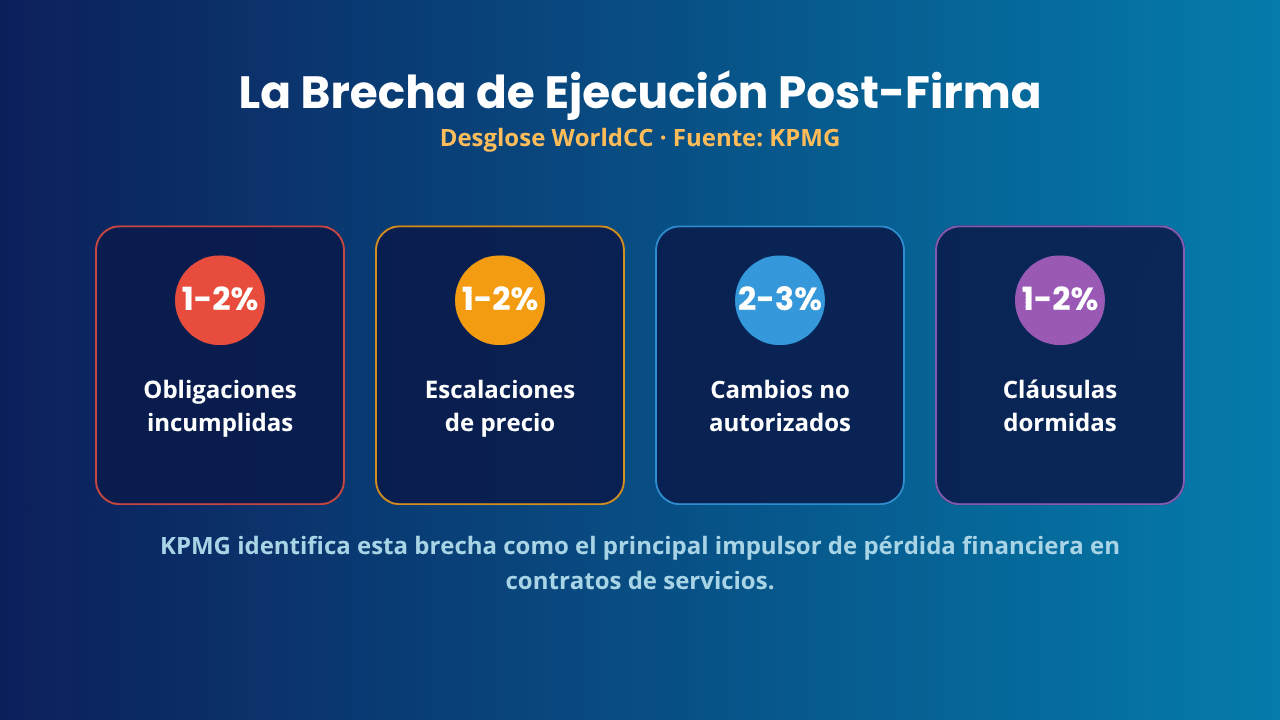
The size of the phenomenon is documented. World Commerce & Contracting (WorldCC) estimates that the average company loses 9.2% of its annual revenue to poor contract management, a figure remarkably consistent with the 9.25% benchmark IT Experts has built over three decades of contract audits. WorldCC’s breakdown attributes the leakage to unmet obligations (1–2%), price escalations (1–2%), unauthorized or unrecorded changes (2–3%) and gain-share, benchmark and innovation clauses that remain dormant from signing (1–2%). KPMG, for its part, identifies the “post-signing execution gap” as the main driver of financial loss in services contracts, and its joint research with WorldCC indicates that about 90% of organizations operate with ineffective, fragmented contracting processes.
Reading this data correctly requires separating where leakage shows up from where it originates. The mechanisms operate after signing, but their enabling conditions are agreed before: the narrow scope is designed in the proposal, the price asymmetry is agreed in the negotiation, the clause that will never be enforced is signed already dormant. That is why the contract must be understood and managed as a full lifecycle, with a pre-signing phase where leakage is sown or prevented and a post-signing phase where it is harvested or contained, and not as an event that ends with the award.
Recovery methodology: the case resolved
The renegotiation of the contract described followed a sequence that is now a replicable methodology. The enabling decision was strategic before it was technical: not to renew, but to take the service to a competitive bid. Putting the account back on the market restored the competitive pressure that 150 bilateral negotiations had removed, and produced an unexpected extra benefit: other vendors’ proposals brought fresh perspectives on delivery models, pricing structures and execution practices that five years of a single relationship had made invisible.
On that basis, three steps were carried out. First, a forensic audit of the PCRs: the 150 changes were reviewed one by one and classified with three questions: how much was scope that should have been in the original contract, how much was charged at rates above the RFP, and how much was duplicated across changes or against the base scope. The result turned 150 scattered documents into a single negotiating argument.
Second, the scope re-baseline: recurring and structural changes were absorbed into a renegotiated base scope, at contract rates rather than PCR rates, with the live benchmark from the competitive process on the table. Third, the redesign of additional services: the ARCs were restructured to charge only the real variable part, removing the duplication against base charges.
The most significant result was structural: the scope of the vast majority of the 150 PCRs was included in the new contract’s base scope without increasing its value. The conclusion is unavoidable: what was billed as extra for five years always fit in the price. And the new contract added the governance mechanisms the first one lacked: change accumulation thresholds that trigger a formal renegotiation, change rates tied to the contract, and a single record of the current scope visible to both parties. The vendor, by the way, kept the account, but it kept it by competing.
The operational question: what is your contract’s current scope?
For any organization with outsourcing contracts more than two years into their term, the acid test is a single question: what is the contract’s current scope today, not the one in the signed document but the real one, base plus accumulated changes, with their rates and duplications? Experience shows that fewer than one in ten executives can answer it, and not out of negligence: the contract lives in a PDF, the changes live in email threads, and no function has the consolidated view. WorldCC confirms it: 87% of organizations report a high level of uncertainty about their own agreements.
The market is responding to this gap with a visible shift: Contract Lifecycle Management is no longer a legal matter but a financial discipline, with global investment growing at double digits. Technology, however, does not replace judgment: it detects patterns, but deciding what to dispute, what to renegotiate and what to redesign requires contract experience on the client’s side. The right order is to first understand where value is leaking, and then put the control in place.
The first step is available at no cost: a 14-question maturity self-assessment that gives you, in five minutes, your organization’s contract management maturity level and its estimated value leakage range. Take the Contract Maturity Test.
|
Is your IT contract leaking value right now? We run a 30-minute Governance Maturity Assessment to identify your critical leakage points and quantify the value that is being left on the table today. No cost. No commitment. Just evidence. |
About the author
William D. López is an independent IT consultant with more than 30 years of experience negotiating and governing technology contracts in Latin America. Founder of IT Experts Consultoría, he has led optimization processes in more than 8 countries with cost reductions of 9% to 35%. He publishes weekly analyses on Value Leakage, strategic sourcing and AI for CFOs and CIOs on LinkedIn.